Sacred Concrete: The Fight to Preserve Britain's Vanishing Clubland Cathedrals
The Demolition Derby
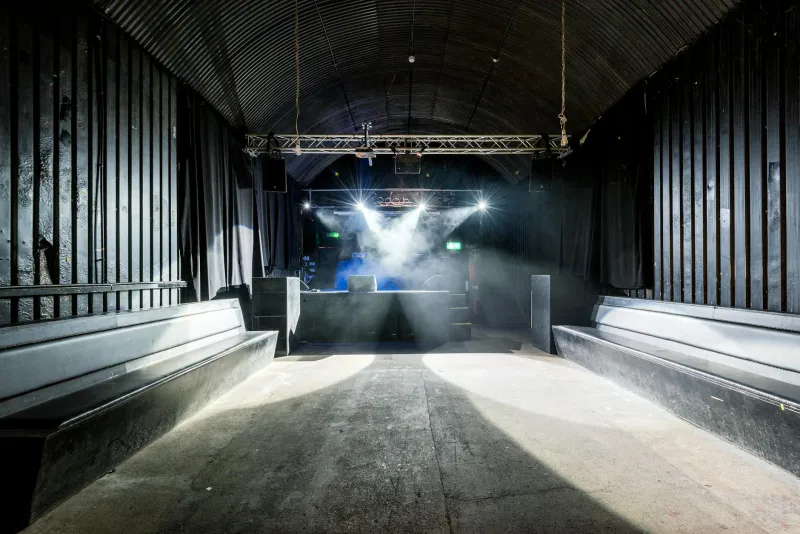
In a nondescript Birmingham suburb, bulldozers recently tore down what locals called "the cathedral of bass." The Que Club, a brutalist concrete box that hosted everyone from Goldie to Carl Cox across three decades, was reduced to rubble to make way for student accommodation. No blue plaque marks its passing. No heritage protection saved its walls that had absorbed a million conversations, declarations of love, and life-changing musical moments.
 Photo: The Que Club, via thecitylane.com
Across Britain, this scene repeats with alarming frequency. Since 2010, over 200 significant nightclub venues have been permanently closed, demolished, or converted beyond recognition. Unlike Victorian theatres or Georgian assembly rooms, these temples of modern culture receive no heritage protection whatsoever.
"We're witnessing cultural vandalism on an industrial scale," declares Dr. Miranda Foster, an architectural historian leading the campaign for nightclub preservation. "These buildings are as significant to British cultural history as any medieval church, yet we're allowing them to disappear without trace."
The Memory Keepers
Foster isn't alone in her mission. A growing network of preservationists, dubbed the "Memory Keepers" by supporters, is documenting and fighting to save Britain's most culturally significant club spaces before they vanish forever.
Their most high-profile victory came in 2023 when they successfully lobbied for Grade II listing of Sheffield's Leadmill, preventing its demolition for a retail development. The campaign highlighted how the venue's distinctive industrial architecture had shaped the sound and spirit of British electronic music.
"The Leadmill's listing was a watershed moment," explains campaign coordinator James Mitchell. "It proved that nightclub buildings can be recognised as legitimate architectural and cultural heritage. Now we need to extend that protection across the country."
The group has identified forty-seven venues they consider "critically endangered," including Manchester's legendary Sankeys (already converted to flats), London's Cable (demolished in 2020), and Liverpool's Cream (facing uncertain future). Each represents not just a building, but an entire ecosystem of cultural memory.
Architecture of Ecstasy
What makes a nightclub building worth preserving? According to architectural critic Tom Wilkinson, it's about understanding how physical space shapes cultural experience.
"Great club architecture isn't about pretty facades," Wilkinson argues. "It's about acoustics, sightlines, circulation patterns, and atmosphere. The way Fabric's concrete arches channel bass frequencies isn't accidental – it's architectural genius that can't be replicated."
The preservationists point to specific design elements that make certain venues irreplaceable. Ministry of Sound's sloped concrete floors, designed to optimise bass response. Heaven's railway arch ceiling that creates unique acoustic properties. The Hacienda's factory floor layout that democratised the dancefloor experience.
 Photo: The Hacienda, via cdn.vox-cdn.com
"These spaces were purpose-built laboratories for collective joy," explains Foster. "The architects who designed them understood something profound about human behaviour and sonic experience. That knowledge is embedded in the physical fabric of these buildings."
The Economics of Memory
Opposing the preservation movement are powerful economic forces. Prime urban locations occupied by clubs represent millions in potential development value, particularly for residential conversion. Developers argue that housing shortages trump nostalgic concerns about old nightclubs.
"You can't preserve every building that once had cultural significance," counters property developer Marcus Webb, whose company has converted twelve former club venues into luxury apartments. "Cities evolve. Trying to freeze nightclub buildings in amber prevents necessary urban regeneration."
The preservationists acknowledge the economic pressures but argue for more creative solutions. They've proposed models where clubs could operate on ground floors whilst residential developments occupy upper levels, preserving the cultural space whilst meeting housing needs.
Digital Archaeology
Recognising that many venues can't be saved physically, the Memory Keepers have launched an ambitious digital preservation project. Using 3D scanning technology, they're creating virtual reconstructions of endangered clubs before demolition.
"If we can't save the buildings, we can at least preserve their spatial memory," explains digital archaeologist Sarah Chen, who leads the scanning programme. "These virtual models capture not just how spaces looked, but how they felt – the sightlines, the acoustic properties, the flow patterns that made each venue unique."
The project has already documented fifteen demolished venues, creating detailed digital archives that researchers and artists can explore. Some virtual reconstructions are being used to inform new venue designs, ensuring that lessons learned in lost spaces can influence future club architecture.
The Sound of History
Beyond architectural significance, preservationists argue that club buildings represent crucial chapters in Britain's musical heritage. The sticky floors of Liverpool's Cavern Club witnessed the birth of Merseybeat. Manchester's Hacienda factory floor hosted the acid house revolution. London's Blitz nightclub spawned the New Romantic movement.
"These buildings are where British music culture was forged," insists music journalist Helen Sharp, who's documenting venue histories for the preservation campaign. "We protect the houses where famous writers lived – why not the clubs where revolutionary music was born?"
Some venues have already achieved informal heritage status through cultural recognition. The 100 Club on Oxford Street, which hosted punk's first stirrings, receives Arts Council funding partly based on its historical significance. Fabric's architectural importance has been acknowledged by the Victoria & Albert Museum, which acquired original sound system components for its permanent collection.
The Next Generation
Perhaps surprisingly, the preservation movement's strongest support comes from younger clubbers who never experienced many of the threatened venues in their heyday. Social media has created communities of "venue archaeologists" who research and document club histories, understanding that these spaces shaped the culture they've inherited.
"I never went to the original Hacienda, but I understand its importance," explains twenty-three-year-old preservationist Jake Morrison. "These buildings are our cultural DNA. Losing them is like burning libraries."
The movement is gaining political support too. Several MPs have tabled parliamentary questions about protecting culturally significant nightlife venues, whilst Historic England has indicated willingness to consider club buildings for heritage listing if compelling cases are made.
Sacred Spaces
As Britain's nighttime economy continues evolving, the fight to preserve its architectural heritage intensifies. The Memory Keepers know they can't save every threatened venue, but they're determined to ensure that the most significant spaces receive the protection they deserve.
"These buildings witnessed transformative moments in British culture," Foster concludes. "They deserve the same reverence we show ancient churches or historic theatres. They're sacred spaces too – just sacred to different gods."
Whether future generations will thank the preservationists for their efforts remains to be seen. But in a rapidly changing urban landscape, their campaign represents something vital: the recognition that cultural memory deserves physical protection, even when that culture happens to involve bass bins and smoke machines rather than stained glass and stone altars.